Valley of Flowers Trekking
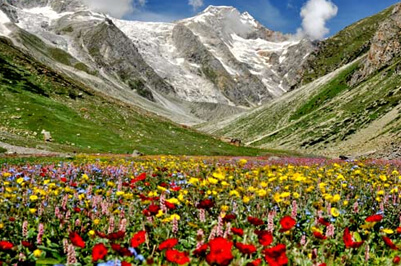
Valley of Flowers is one of the magical wonderlands on Earth, situated high in the Himalayas of the Uttaranchal state in India. It is protected by snow-capped mountains, at an altitude of 3,600 meters above sea level. This valley was discovered by Frank S. Smythe in 1931. It remains snow-covered for almost the whole year and hence remains inaccessible.
The Valley of Flowers trek has a lot of stories about it. These stories are usually about travelers feeling unconscious from the heavy scent of flowers in this valley. It is a much sought-after haunt for botanists, flower lovers, and, of course, trekkers, for whom a sufficient excuse to start on a mission to reach a place is that it exists. The Valley of Flowers offers about 650 types of different plant species. Some of the very rare plants like Blue Poppy, Ladies Sleeper Orchid, and Braham Kamal, etc., are the ones that can be found here. The valley has a dense forest of Bhoj Patra and is located on one side of the Pushpawati River.
Trekking Route of the Valley of Flowers
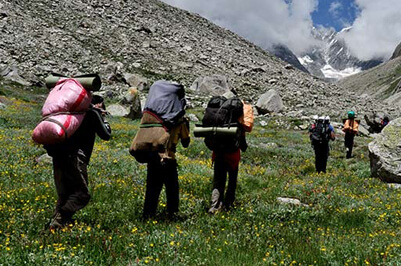 First Day Trek – Starts from Govindghat (1900 mtr) to Ghangaria (3000mtr), 7 hours, 13 kms gradual ascent.
Second Day Trek – Ghangaria to Valley of Flowers (3500 m), back to Ghangaria. 10 km easy ascent followed by a flat walk through the valley and return.
Third Day Trek – Ghangaria to Hemkund Sahib (4300 m) and back to Ghangaria 6 km, 7 hours. Hard climb, 5 hours descent.
Fourth Day Trek – The Fourth day trek will start from Ghangaria to Govindghat, 13 kms. Easy descent, 5 hours.
Best Time to Visit
If you want to see the valley of flowers, you need to plan the trek right now. The month of July and August, when the monsoon is active, is the best time to trek here.
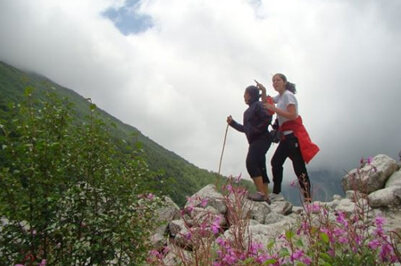
In May, The Valley of flowers becomes accessible in the month of May when the snow starts melting. In the month of May, one can see a lot of snow but a very small number of flowers. There is a big advantage of visiting in May, which is that there will be less rain or no rain at all, as the rainy season starts in the last week of June.
In June and July During these months, one can enjoy watching waterfalls and beautiful glaciers in the valley of flowers. The big benefit of visiting in this month is that there will be very less rainfall.
In August and September, as the snow starts melting in May and new plants start germinating and grow till August. One can see a lot of flowers blooming till mid-August. The best time to see the maximum number of flowers is August and September. One can say this is the last month for visiting the Valley of Flowers. The plants and flowers start drying up and drop their seeds on the earth for the next season.
Note: Tourists have no authority to stay in the Valley of Flowers. There is no accommodation facility inside the park. If you want to travel in this amazing valley, you have to stay at a private lodge or hotel.
How to Reach
By Road, Chopta is well connected with other routes via road. Chopta is on the way to the Ukhimath road. One can easily book buses and taxis from all major towns of Uttarakhand. The Valley of Flowers is well connected to Govindghat. From here, you have to commence a 16 kms trek to reach the Valley of Flowers. Govindghat is well connected by road with major destinations of Uttarakhand state by transportation. Cars, buses, and taxis are easily available from Rishikesh city or Haridwar.
By train, the nearest railway station to reach the Valley of Flowers is Rishikesh. From here, you have to manage a car or a bus to Govindghat. Valley of Flowers is not far from Govindghat, only 16 kms. Rishikesh city is well connected by railways and road networks with major destinations in India.
By Air, Jolly Grant Airport is the nearest airport to here, but the road is only connected up to Govindghat. Then, you have to trek for 16 kms to reach the Valley of Flowers. Govindghat is located at a distance of only 292 kms from Jolly Grant Airport and is well connected by motorable roads. Jolly Grant Airport is also well connected to Delhi.